
22 4 月, 2026 • 4 min read
How Does a CNC Press Brake Work?
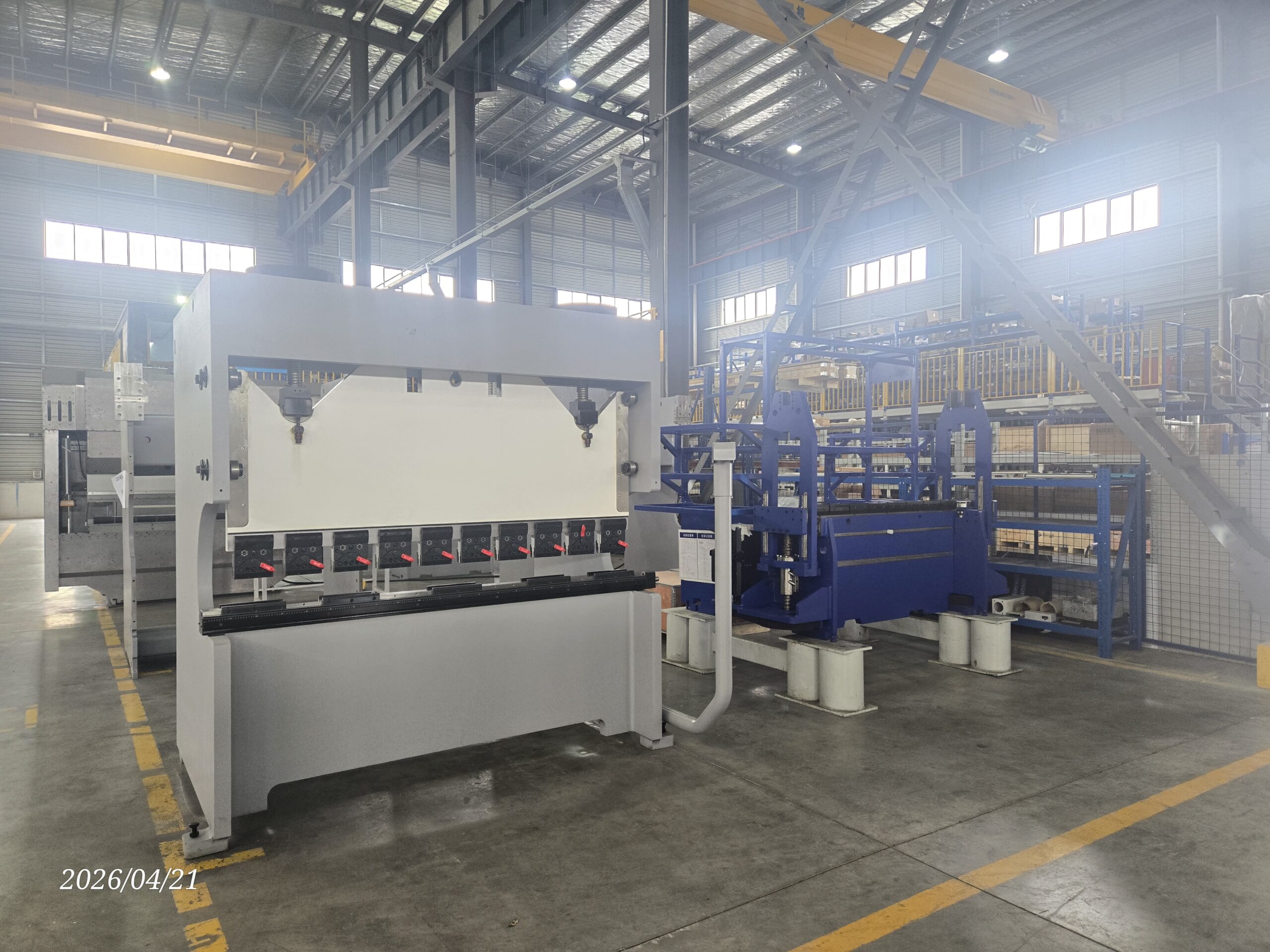
Introduction
CNC press brakes have become a fundamental part of modern sheet metal manufacturing. Compared with manually controlled bending equipment, CNC systems can coordinate machine movement, positioning, bending sequences, and production data with a high level of repeatability.
But how does a CNC press brake actually work?
The answer involves much more than simply moving an upper beam up and down. A modern CNC press brake combines mechanical structure, drive systems, tooling, sensors, software, and positioning technology to turn flat sheet metal into accurately formed components.
Understanding these systems is useful not only for machine operators but also for manufacturers and buyers evaluating new bending equipment.
The Basic Working Principle
A CNC press brake bends sheet metal by applying controlled force between an upper punch and a lower die.
The sheet is placed on the lower tooling and positioned using the backgauge. The upper beam then moves downward according to a programmed position.
As the punch enters the die opening, the sheet deforms and forms the required angle.
After reaching the programmed position, the upper beam retracts and the finished bend is released.
The process is repeated according to the programmed bending sequence.
Although the basic principle is simple, the accuracy of the final part depends on how precisely the machine controls every stage of this process.
The Main Components of a CNC Press Brake
Machine Frame
The frame provides the structural foundation of the machine.
During bending, the machine experiences substantial forces. A rigid frame helps maintain the relationship between the upper and lower tooling and reduces unwanted deformation.
Machine rigidity is therefore an important consideration when evaluating bending accuracy.
Upper Beam
The upper beam carries the punch and moves vertically during the bending cycle.
The movement must be controlled precisely because the ram position directly affects the bending angle.
Lower Beam and Die
The lower beam supports the die.
Different die openings and geometries can be selected according to the material, thickness, bend radius, and required part geometry.
CNC Control
The CNC control is effectively the machine's operating center.
Depending on the configuration, it can manage:
- Bending angles
- Ram position
- Backgauge movement
- Bending sequence
- Tool information
- Material parameters
- Program storage
- Production data
Advanced systems can also support graphical programming and automatic sequence calculation.
What Does the Backgauge Do?
The backgauge positions the sheet before each bend.
This is one of the most important systems for repeatable production.
Imagine manufacturing a component with several bends. The operator cannot simply place the sheet approximately in the same position each time. Even a small positioning error can affect the final dimensions.
The backgauge provides a controlled reference point.
Depending on the machine, a CNC press brake may have several controlled backgauge axes. More axes provide additional positioning flexibility, especially when producing complex parts.
However, the correct configuration should always be determined by actual part requirements.
What Happens During a Bending Cycle?
A typical CNC bending cycle includes several stages.
Step 1: Programming
The operator enters or imports the part geometry and production parameters.
Step 2: Tool Selection
The appropriate punch and die are selected.
Step 3: Material Positioning
The operator places the sheet against the backgauge.
Step 4: Pre-Bending Movement
The CNC system positions the ram and backgauge according to the programmed sequence.
Step 5: Bending
The upper beam moves downward and applies controlled force to form the material.
Step 6: Retraction
The beam returns to its programmed position.
Step 7: Repositioning
For multi-bend components, the backgauge moves to the next programmed position.
Step 8: Repeat
The process continues until all bends are completed.
This sequence can be repeated for multiple parts with a high degree of consistency.
How Does the CNC Control Improve Accuracy?
One of the main advantages of CNC control is repeatability.
A skilled operator can produce accurate parts manually, but relying entirely on operator judgment becomes increasingly difficult as production volume and part complexity increase.
CNC control reduces the amount of manual positioning required.
The machine can repeatedly execute the same programmed movements, which helps reduce variation between parts.
Modern systems may also use angle measurement or compensation technologies to detect and correct deviations during production.
Why Is Material Variation Important?
A common misconception is that if the machine is accurate, every bend will automatically be identical.
In reality, the material itself can vary.
Two sheets with the same nominal thickness may behave slightly differently because of differences in:
- Material grade
- Hardness
- Tensile strength
- Thickness
- Rolling direction
- Surface condition
These differences can influence the final bending angle.
This is why high-level bending systems increasingly combine machine accuracy with process compensation and measurement technology.
Air Bending on a CNC Press Brake
Air bending is widely used because it provides flexibility.
The punch does not fully flatten the material into the bottom of the die. Instead, the bending angle is determined largely by the punch penetration depth.
The CNC system therefore needs accurate control of ram position.
Changing the die opening can also affect the resulting bend radius and force requirements.
For this reason, tooling information should be integrated into the bending program whenever possible.
What Is Bending Sequence?
Many components require several bends.
The order in which those bends are performed is called the bending sequence.
A poor sequence can create several problems:
- Tool interference
- Part collision
- Difficult handling
- Positioning problems
- Increased cycle time
An optimized bending sequence can make production faster and safer.
For complex parts, software-assisted sequence calculation can significantly reduce programming time.
What Should Buyers Look for in a CNC Press Brake?
When evaluating a CNC press brake, buyers should look beyond tonnage.
Important factors include:
- Frame rigidity
- Bending length
- Maximum bending force
- CNC control
- Backgauge configuration
- Tool compatibility
- Positioning accuracy
- Repeatability
- Safety systems
- Service support
- Availability of spare parts
- Automation compatibility
For professional buyers, the question should not simply be "How powerful is the machine?"
A better question is:
How well does this machine fit our production process?
When Should You Consider Automation?
Automation becomes attractive when production volume, labor availability, consistency requirements, or product complexity justify the investment.
Examples include:
- Robotic press brake bending
- Automatic tool changing
- Sheet loading and unloading
- Material storage
- Integrated laser cutting and bending
- Flexible production lines
The objective of automation should not be automation for its own sake.
The real objective is to improve the overall production system.
Final Thoughts
A CNC press brake is a combination of mechanical precision, digital control, tooling technology, and production workflow.
Understanding how these elements work together makes it easier to select the right equipment and identify the specifications that actually matter.
For KLD Machinery, this system-level approach is central to the way we develop sheet metal solutions. A press brake should not be evaluated as an isolated machine, but as part of the customer's complete production process.
Frequently Asked Questions
Is a CNC press brake difficult to operate?
Modern CNC systems are designed to simplify programming and operation. However, understanding tooling, materials, bending principles, and production sequences remains important.
Does more CNC axes always mean better performance?
No. Additional axes provide more positioning flexibility, but the ideal configuration depends on the complexity of the parts being produced.
Can a CNC press brake bend stainless steel?
Yes. CNC press brakes can process stainless steel when the machine capacity, tooling, and process parameters are correctly selected.
What is the most important factor in bending accuracy?
Accuracy depends on the complete system, including machine rigidity, positioning, tooling, material characteristics, control, and process compensation.
For More Details, Consult Your KLD Sheet Metal Solution Experts
We help you deliver the quality and value required for sheet metal processing equipment.
Consult Our Experts →