7 5 月, 2026 • 4 min read
What Is a Press Brake? A Complete Guide to Sheet Metal Bending
Learn what a press brake is, how it works, the main types of bending processes, and how to choose the right press brake for your sheet metal production.
What Is a Press Brake?
A press brake is a machine tool used to bend sheet metal into precise angles and shapes. It is one of the most important machines in modern sheet metal fabrication and is widely used in industries such as electrical cabinets, HVAC, elevators, automotive components, steel furniture, construction equipment, and general metal fabrication.
The basic principle is straightforward: a sheet of metal is positioned between an upper punch and a lower die. The punch moves downward and applies force to the material, causing it to deform and form the required angle.
Modern press brakes, however, are much more than simple bending machines. CNC controls, multi-axis backgauges, angle measurement systems, advanced tooling, and automated material handling have transformed press brake bending into a highly precise and increasingly automated manufacturing process.
How Does a Press Brake Work?
A typical press brake consists of several major systems:
- Machine frame
- Upper beam and punch
- Lower beam and die
- Hydraulic or electric drive system
- CNC control
- Backgauge system
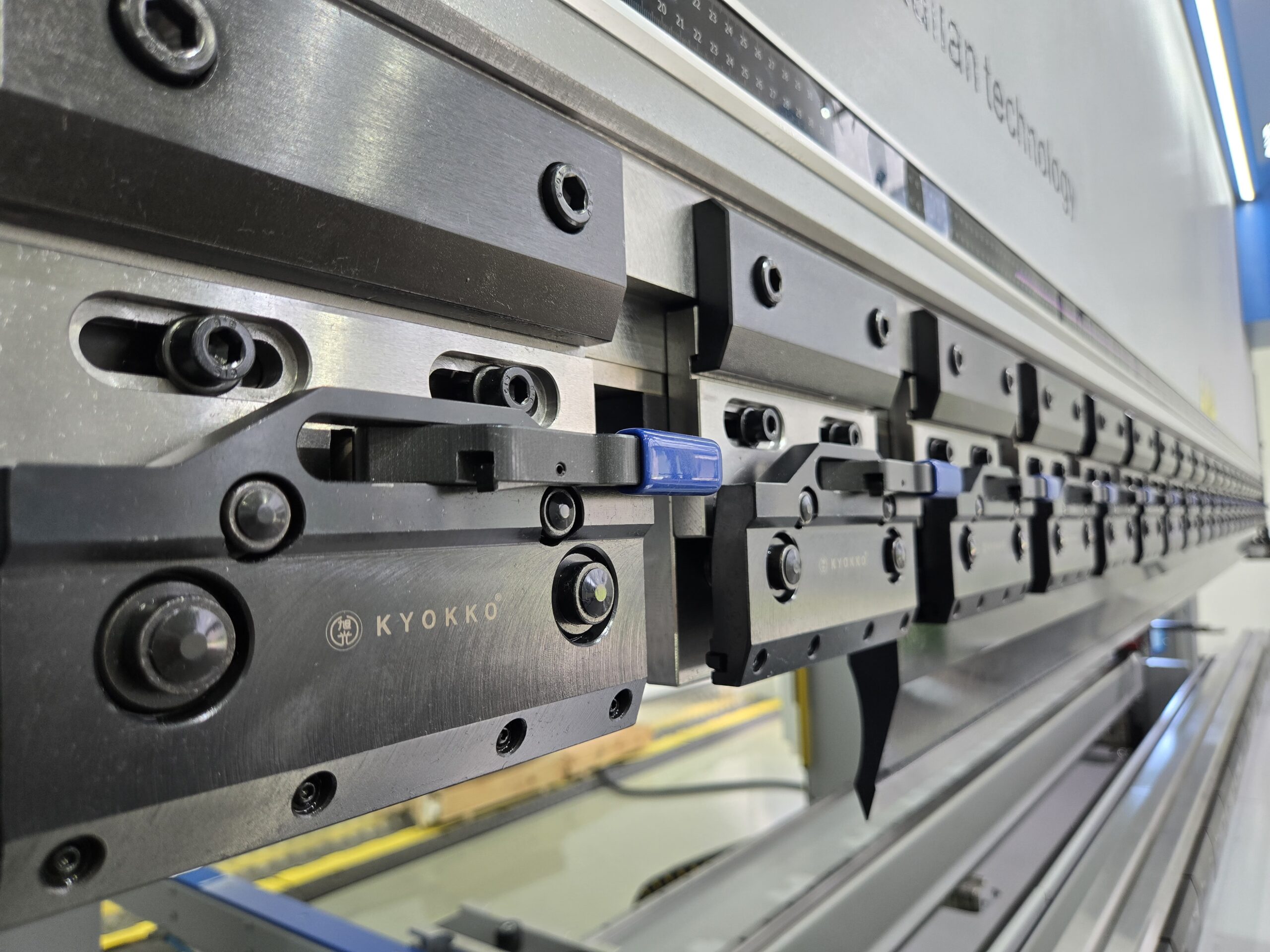
- Tooling
- Safety system
The operator or production software first defines the required bending sequence. The sheet is then positioned against the backgauge. The upper beam moves downward and forces the sheet into the lower die.
The final bending angle depends on several factors, including material type, thickness, tooling, die opening, bending force, and machine position.
In modern CNC press brakes, the control system coordinates these movements automatically. This allows manufacturers to produce complex parts with high repeatability while reducing operator intervention.
What Are the Main Types of Press Brakes?
Press brakes can be classified in several ways.
Hydraulic Press Brake
Hydraulic press brakes use hydraulic cylinders to generate bending force. They remain one of the most widely used solutions for industrial sheet metal production.
Their advantages include:
- High bending capacity
- Flexible configuration
- Ability to process a wide range of materials
- Suitable for medium and heavy-duty applications
Hydraulic CNC press brakes are particularly useful for manufacturers that need flexibility across different material thicknesses and part sizes.
Servo Electric Press Brake
Servo electric press brakes use electric servo motors and mechanical transmission systems instead of conventional hydraulic power.
Their key advantages can include:
- High energy efficiency
- Fast response
- Reduced hydraulic maintenance
- High repeatability
- Suitable for high-volume production
They are especially attractive for manufacturers whose production involves many repeated parts and relatively light or medium sheet thicknesses.
Hybrid Press Brake
Hybrid systems combine hydraulic and electric technologies to achieve a balance between force, speed, efficiency, and control.
The appropriate machine type depends on the actual production requirements rather than simply choosing the newest technology.
What Is CNC Control in a Press Brake?
CNC stands for Computer Numerical Control.
On a modern CNC press brake, the operator can enter or import part dimensions, bending angles, material information, and tooling parameters. The control system then calculates and coordinates the required machine movements.
Depending on the machine configuration, CNC-controlled axes may include:
- Y-axis for ram movement
- X-axis for backgauge positioning
- R-axis for backgauge height
- Z-axis for lateral positioning
- Crowning compensation
More axes do not automatically mean a better machine. The correct configuration depends on the complexity of the parts being produced.
For example, a manufacturer producing simple brackets may not need the same backgauge configuration as an OEM producing complex multi-bend components.
What Is Air Bending?
Air bending is one of the most common bending methods.
During air bending, the sheet does not fully contact the bottom of the die. Instead, the punch presses the material into the V-shaped opening while the material remains partially supported by the die shoulders.
The bending angle is controlled primarily by how far the punch travels into the die.
This method provides considerable flexibility because one tooling setup can produce different angles by changing the ram position.
Air bending is therefore widely used in modern CNC press brake production.
What Is Press Brake Tonnage?
Press brake tonnage refers to the amount of force the machine can apply during bending.
Choosing the correct tonnage is critical.
The required bending force depends on factors such as:
- Material type
- Material thickness
- Bending length
- Die opening
- Bending method
- Part geometry
A machine with insufficient tonnage may not be able to form the required part safely or accurately.
However, buying a machine with significantly more capacity than necessary is not always the best investment either. Oversizing can increase machine cost without providing meaningful production benefits.
The objective should be to select a machine with sufficient capacity and an appropriate safety margin for the intended workload.
Why Does Tooling Matter?
Press brake tooling directly affects bending quality.
The punch and die determine how the sheet is positioned and deformed. Tool geometry, die opening, punch radius, tooling condition, and setup accuracy can all influence the final result.
Tooling selection becomes particularly important when manufacturers process different materials or produce parts with complex geometries.
High-quality tooling can improve repeatability, reduce setup problems, and extend service life. For this reason, tooling should be considered as part of the complete bending system rather than as an accessory.
How Do You Choose the Right Press Brake?
A machine should be selected based on the production process rather than a single specification.
Before purchasing a press brake, consider:
1. Material
Identify the materials you regularly process, such as mild steel, stainless steel, aluminum, or other alloys.
2. Thickness
Determine the minimum, average, and maximum material thickness.
3. Bending Length
Consider the longest parts you need to manufacture.
4. Production Volume
A job shop with highly variable orders may have different requirements from an OEM producing thousands of similar components.
5. Part Complexity
The number of bends, bending sequence, positioning requirements, and part geometry all influence the ideal machine configuration.
6. Automation Requirements
If labor availability is a concern or production volume is increasing, automated tool changing, robotic bending, or material handling may become important.
Press Brake vs. Bending Machine: Is There a Difference?
The terms are sometimes used interchangeably.
"Press brake" is the more specific industry term for a machine designed primarily for sheet metal bending using a punch and die system.
"Bending machine" is a broader expression that can describe several different types of equipment.
When communicating with international suppliers or customers, "press brake" and "CNC press brake" are generally the more precise terms for conventional punch-and-die sheet metal bending equipment.
Final Thoughts
A press brake is not simply a machine that applies force to sheet metal. It is a complete production system involving machine structure, control technology, tooling, material characteristics, programming, and operator workflow.
For manufacturers, the best press brake is not necessarily the machine with the highest tonnage or the largest number of features. It is the machine configuration that matches the company's actual products, production volume, material range, quality requirements, and future development plans.
At KLD Machinery, our approach is to look beyond the machine itself and understand how bending equipment fits into the customer's overall sheet metal production process. From CNC press brakes to panel bending and automated solutions, the goal is to build equipment around real production requirements.
Frequently Asked Questions
What is a press brake used for?
A press brake is mainly used to bend sheet metal into specific angles and shapes for manufacturing components and finished products.
What is the difference between a CNC press brake and a conventional press brake?
A CNC press brake uses computerized control to coordinate machine movement and positioning, improving repeatability and simplifying the production of complex parts.
Is hydraulic or electric better for a press brake?
Neither technology is universally better. The right choice depends on material thickness, production volume, speed requirements, energy considerations, and application.
How much tonnage do I need?
Required tonnage depends on material, thickness, bending length, tooling, die opening, and bending method. It should be calculated for the actual application rather than selected by machine size alone.
For More Details, Consult Your KLD Sheet Metal Solution Experts
We help you deliver the quality and value required for sheet metal processing equipment.
Consult Our Experts →