
2 9 月, 2026 • 4 min read
Flexible Robotic Bending for Multiple Sheet Metal Sizes and Products
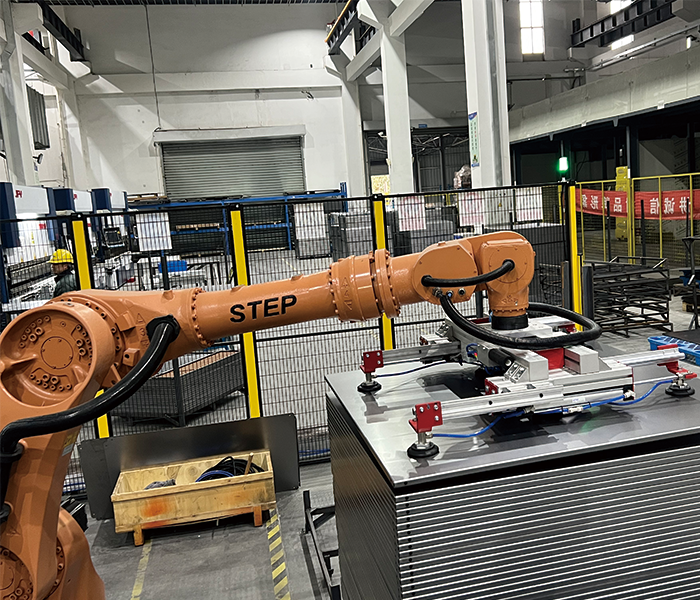
Designing Automation Around Product Variety
Automation is often associated with high-volume production of identical parts.
But modern manufacturers increasingly need another type of automation:
Flexible automation.
This KLD case involved a customer producing large and thick sheet metal components with significant variation in workpiece size and product type.
The challenge was to automate the bending process without creating a system that could only handle one fixed product.
The Production Requirement
The customer needed to process different workpieces while maintaining an automated bending workflow.
This created several requirements:
- Flexible material handling
- Adjustable positioning
- Automatic workpiece recognition
- Different workpiece dimensions
- Reliable bending positioning
- Adaptable gripping
A standard fixed automation cell would not fully address these requirements.
The KLD Solution
KLD developed a customized robotic bending cell around a CNC press brake.
The system includes:
- 6-axis robot
- 7th robot axis
- 3D vision
- Customized gripper
- Adjustable-angle gravity positioning table
- Automatic turning frame
- Automatic thickness detection
- 6-axis backgauge
- Pneumatic following system
- Automatic front feeding
- Safety guarding
Each component addresses a different part of the flexibility challenge.
Adjustable Positioning
An adjustable-angle gravity positioning table helps establish a controlled reference position for different workpieces.
The automatic turning frame further supports workpiece handling when different orientations are required.
These systems reduce the need for operators to manually manipulate large sheets throughout the bending process.
Flexible Robot Movement
The 6-axis robot provides multiple degrees of movement, while the additional 7th axis extends the robot's working range.
This configuration is particularly useful when handling large workpieces around a press brake.
Instead of designing the production process around the limited movement of a standard robot, the additional axis provides greater flexibility within the cell.
Automatic Recognition
The integration of 3D vision and thickness detection adds another level of adaptability.
Different workpieces may have different dimensions or material characteristics.
Automatic detection can provide the control system with additional production information before the bending operation.
This supports a more flexible production strategy.
Why Flexible Automation Matters
For manufacturers with changing product requirements, automation must evolve with the business.
A rigid automation system may perform extremely well for one part but become difficult to use when the product changes.
Flexible automation aims to reduce this limitation.
The objective is to create a system capable of handling a family of products, rather than only one specific component.
The Bigger Picture
This application demonstrates the shift from traditional fixed automation toward flexible sheet metal manufacturing.
The combination of robotics, vision, automatic positioning, and CNC bending creates a more adaptable production environment.
For manufacturers producing multiple sizes and types of large sheet metal components, this approach can provide a stronger foundation for future automation.
KLD Machinery develops flexible robotic bending solutions around actual product portfolios, helping manufacturers move toward more adaptable sheet metal production.
For More Details, Consult Your KLD Sheet Metal Solution Experts
We help you deliver the quality and value required for sheet metal processing equipment.
Consult Our Experts →