
21 9 月, 2026 • 4 min read
Building an Industry 4.0 Ready Robotic Bending Cell
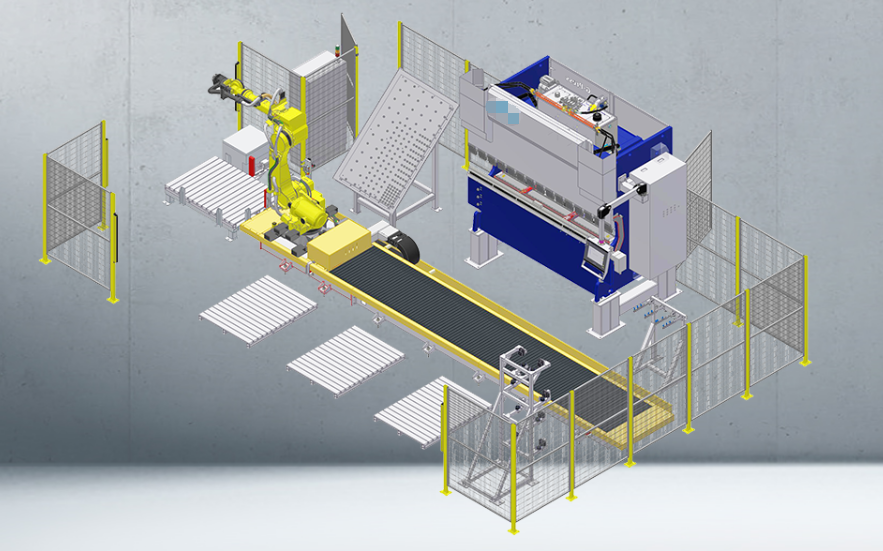
An Industry 4.0 robotic bending cell integrates CNC press brake technology, industrial robotics, automated material handling, and coordinated control systems into a connected sheet metal manufacturing process.
Instead of treating each machine as an independent workstation, an integrated bending cell coordinates workpiece loading, positioning, bending, unloading, and production monitoring.
For manufacturers processing large or varied sheet metal components, this approach can reduce manual handling, improve process consistency, and support more flexible production.
However, building an effective robotic bending cell requires more than installing a robot beside a press brake.
The success of the system depends on mechanical integration, robot reach, workpiece positioning, tooling compatibility, safety engineering, and reliable communication between equipment.
This KLD application illustrates how these technologies can be combined to support automated sheet metal bending.
A smart factory does not begin with software alone. It begins with a well-designed production process.
From Individual Machines to an Integrated Cell
A traditional production line may treat each machine as a separate operation.
An Industry 4.0 approach looks at the complete workflow.
In this application, the bending cell integrates:
- CNC press brake
- 6-axis industrial robot
- 7th robot axis
- 3D vision
- Automatic thickness detection
- Adjustable positioning
- Automatic turning frame
- Customized gripper
- 6-axis backgauge
- Pneumatic feeding systems
- Safety system
Each component performs a specific function, but the greater value comes from their coordination.
Sensing + Automation
One important characteristic of the system is the use of sensing technology.
3D vision provides information about the workpiece.
Automatic thickness detection provides additional material information.
These inputs can support automated handling and bending decisions.
This is fundamentally different from a simple fixed automation process where every workpiece must arrive in exactly the same condition.
Flexible Manufacturing
The customer produces large and thick sheet metal components with different sizes and product types.
This creates a strong requirement for flexibility.
The adjustable positioning system, robot axes, customized gripper and sensing technologies are designed to help the system accommodate this production variation.
For modern manufacturers, this flexibility can be important as product portfolios become more diverse.
Why Industry 4.0 Matters
An Industry 4.0 robotic bending cell integrates CNC press brake technology, industrial robotics, automated material handling, and coordinated control systems into a connected sheet metal manufacturing process.
Instead of treating each machine as an independent workstation, an integrated bending cell coordinates workpiece loading, positioning, bending, unloading, and production monitoring.
For manufacturers processing large or varied sheet metal components, this approach can reduce manual handling, improve process consistency, and support more flexible production.
However, building an effective robotic bending cell requires more than installing a robot beside a press brake.
The success of the system depends on mechanical integration, robot reach, workpiece positioning, tooling compatibility, safety engineering, and reliable communication between equipment.
This KLD application illustrates how these technologies can be combined to support automated sheet metal bending.
A smart factory does not begin with software alone. It begins with a well-designed production process.
Industry 4.0 should not mean adding technology simply because it is available.
The purpose is to create a manufacturing process that is:
- More connected
- More automated
- More adaptable
- More traceable
- Less dependent on repetitive manual operations
A robotic bending cell can become one building block within a larger smart manufacturing system.
Looking Beyond the Bending Machine
In a future production environment, the bending cell can potentially connect with upstream and downstream processes such as:
Material Storage → Laser Cutting → Sorting → Bending → Welding → Assembly
This creates a broader manufacturing architecture rather than isolated machines.
For manufacturers planning future automation, it is therefore important to consider machine connectivity and expansion capability during the initial equipment investment.
What Should Manufacturers Ask?
When evaluating an Industry 4.0 bending solution, consider:
- Can the system handle different products?
- What sensors are integrated?
- Can production information be exchanged with other systems?
- Can additional automation be added later?
- How flexible is the robot configuration?
- Can the machine connect to upstream and downstream processes?
These questions help determine whether an automation investment can support long-term manufacturing development.
Conclusion
Industry 4.0 in sheet metal manufacturing is not simply about installing robots.
It is about connecting machines, sensors, software, material handling, and production processes into a coordinated manufacturing system.
This KLD case combines robotic bending, 3D vision, automatic thickness detection, positioning technology, and CNC control to create a more flexible automated bending environment.
KLD Machinery develops intelligent sheet metal automation solutions with the goal of connecting individual machines into production systems built around real manufacturing requirements.
Frequently Asked Questions
What is an Industry 4.0 robotic bending cell?
An Industry 4.0 robotic bending cell combines a CNC press brake, industrial robot, material handling equipment, and coordinated control systems to automate sheet metal bending operations.
Can robotic bending cells handle different workpiece sizes?
Yes, provided the robot, grippers, positioning equipment, and bending machine are designed for the required size and weight range. Some applications may require automatic gripping adjustments or additional motion axes.
Does robotic bending eliminate manual operators?
Not necessarily. Automation can reduce repetitive manual handling, but operators may still be required for material replenishment, programming, quality inspection, maintenance, and production supervision.
What determines the productivity of a robotic bending cell?
Productivity depends on bending complexity, robot movement, workpiece handling, loading and unloading time, changeovers, and system reliability. Actual cycle times should be verified through representative production trials.
For More Details, Consult Your KLD Sheet Metal Solution Experts
We help you deliver the quality and value required for sheet metal processing equipment.
Consult Our Experts →