
8 10 月, 2025 • 6 min read
435 Parts in 8 Hours: Increasing Sheet Metal Bending Output with Automation
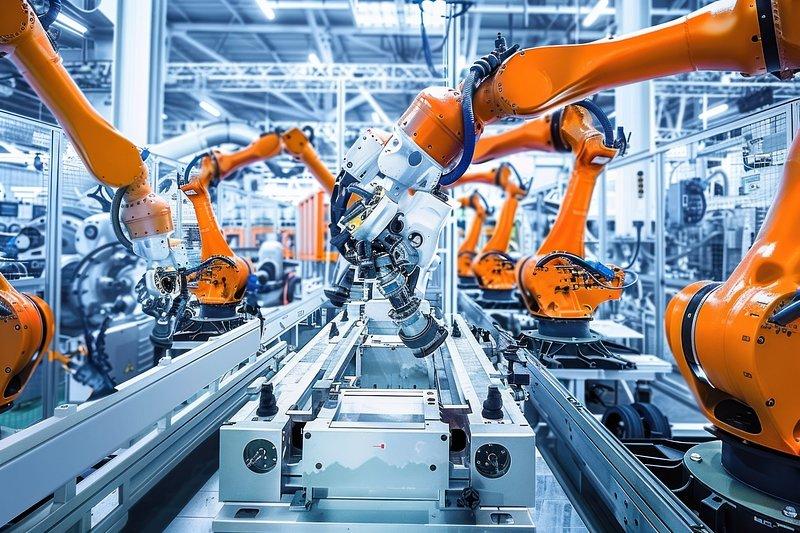
435 Parts in 8 Hours: Increasing Sheet Metal Bending Output with Automation
Sheet metal bending automation can help manufacturers increase production capacity by reducing repetitive handling, improving workpiece positioning, and coordinating bending operations.
For manufacturers producing large quantities of similar components, the challenge is often not the press brake's bending speed alone. Manual loading, rotation, repositioning, and unloading can account for a significant portion of the total production cycle.
This KLD application examines the production efficiency of an automated robotic bending cell designed for 1,200 mm square perforated sheet metal panels.
The Customer's Production Challenge
The customer manufactured square perforated panels requiring bending along four sides.
Before automation, the bending process required two operators to move workpieces from the raw material area, position them at the press brake, perform the required bends, and transfer finished components to the collection area.
The repeated handling operations increased cycle time and limited output.
The customer wanted to improve production capacity without relying on additional manual labor.
The Automated Bending Solution
The automated system combines a CNC press brake, industrial robot, workpiece positioning equipment, and automated handling mechanisms.
The main components include:
- CNC press brake for four-side bending
- Industrial robot for workpiece handling
- Automatic loading mechanism
- Gravity positioning table
- Positioning detection system
- Customized robotic gripper
- Safety enclosure and associated protective devices
The robot transfers each panel through the required bending sequence, reducing the need for repeated manual repositioning.
The remaining operator is responsible for supporting material supply, finished-part collection, and production supervision.
Manual vs. Automated Cycle-Time Comparison
The supplied project data includes ten recorded manual cycles and ten automated cycles.
| Indicator | Manual Bending | Automated Bending |
|---|---|---|
| Operators assigned | 2 | 1 |
| First recorded cycle | 121 seconds | 100 seconds |
| Subsequent cycles | 120–132 seconds | 66 seconds |
| Average of ten cycles | 125.6 seconds | 69.4 seconds |
| Stabilized cycle time | Not separately established | 66 seconds |
The initial automated cycle took longer than subsequent cycles, which is consistent with a startup or first-cycle effect, although the exact cause was not documented.
For the nine subsequent automated cycles, the recorded time remained at 66 seconds per part.
How Was the 435-Parts Figure Calculated?
The estimated output is based on an eight-hour production period and the stabilized automated cycle time.
Eight hours equals 28,800 seconds.
28,800 ÷ 66 ≈ 436 parts
Allowing for rounding and the initial longer cycle gives approximately 435 parts.
More precisely, with one 100-second cycle followed by 66-second cycles, the theoretical eight-hour output is 435 completed parts.
This calculation assumes uninterrupted operation, sufficient material supply, and no additional downtime.
It is a theoretical capacity estimate based on the recorded cycle times, not independently verified actual shift output.
How Much Faster Is the Automated Process?
The recorded manual process averaged 125.6 seconds per part.
The stabilized automated process required 66 seconds.
The cycle-time reduction is:
(125.6 − 66) ÷ 125.6 × 100 ≈ 47.5%
The corresponding theoretical throughput increases from approximately 28.7 to 54.5 parts per hour.
This represents approximately 90% higher theoretical hourly throughput under the stated assumptions.
It is important to distinguish cycle-time reduction from throughput improvement. They are related but are not expressed using the same percentage calculation.
Why Automation Improves Production Efficiency
The improvement comes from coordinating several activities rather than simply increasing press brake speed.
The robot performs repeated material handling movements according to a programmed sequence.
The positioning station helps establish a repeatable workpiece reference.
The press brake performs the bending operations while the handling system manages workpiece orientation.
This arrangement reduces variation associated with repetitive manual handling and supports more predictable cycle times.
What Should Manufacturers Evaluate?
Before investing in similar automation, manufacturers should review workpiece geometry, material thickness, production volume, available floor space, and current labor requirements.
A robotic bending cell is particularly relevant when parts are repetitive and manual handling occupies a substantial share of the production cycle.
However, productivity estimates must also account for changeovers, equipment availability, maintenance, material supply, and quality losses.
KLD Machinery evaluates robotic bending applications using actual part requirements and production workflows to identify suitable equipment configurations.
Frequently Asked Questions
Can robotic bending automation produce 435 parts in eight hours?
The supplied cycle-time data supports a theoretical output of 435 parts under uninterrupted operating conditions. Actual output depends on production availability and operating conditions.
Does robotic bending always double production capacity?
No. Productivity depends on part geometry, handling requirements, bending sequence, and the existing process.
Can automation reduce the number of operators?
Yes, for suitable applications. This case compares a two-operator manual process with a one-operator automated workflow.
What information is required to estimate automated bending output?
Part drawings, material specifications, bending sequence, current cycle time, handling requirements, and production schedule are needed.
Conclusion
This application illustrates how sheet metal bending automation can reduce repetitive handling and increase theoretical production capacity for suitable components.
For the recorded 1,200 mm panel application, the stabilized automated cycle time of 66 seconds supports a calculated capacity of approximately 435 parts in eight hours, subject to uninterrupted operation and the stated assumptions.
For More Details, Consult Your KLD Sheet Metal Solution Experts
We help you deliver the quality and value required for sheet metal processing equipment.
Consult Our Experts →