21 9 月, 2026 • 4 min read
6-Axis Robot + 7th Axis: Why Robot Configuration Matters in Bending
A robotic bending cell is not simply a press brake combined with an industrial robot.
Robot configuration has a direct impact on how efficiently large sheet metal workpieces can be handled.
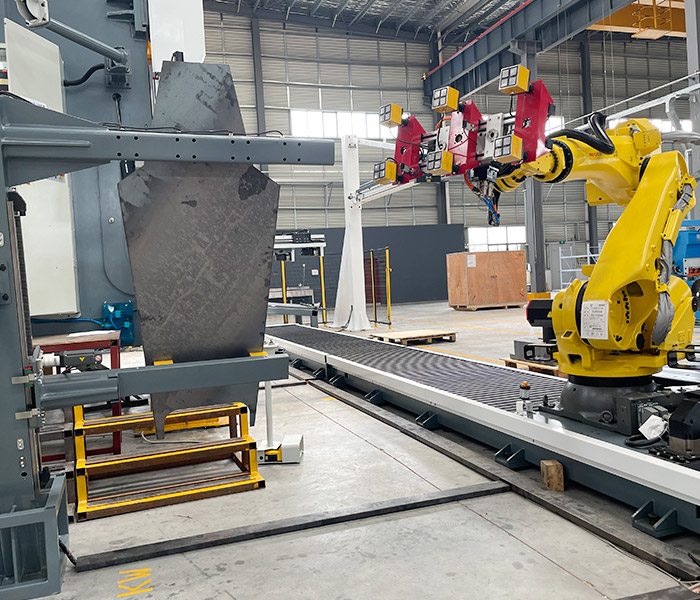
In this KLD application, the automation cell uses a 6-axis industrial robot combined with a 7th axis to support the handling of large and thick sheet metal components.
Why Six Axes?
A conventional 6-axis industrial robot provides multiple degrees of freedom for positioning and rotating the workpiece.
This is important in bending because the robot may need to:
- Pick up the workpiece
- Position it
- Rotate it
- Maintain orientation
- Move around the press brake
- Reposition the sheet between bends
The required movement is significantly more complex than a simple linear loading operation.
Why Add a 7th Axis?
The additional robot axis extends the robot's working range.
This can be particularly useful when the workpiece is large or when the bending cell covers a relatively long working area.
Instead of relying entirely on the robot's standard reach, the robot can move along an additional axis within the cell.
This can improve flexibility when handling larger components.
Designed for Large Workpieces
The KLD case involved large and thick sheet metal components.
This creates different handling requirements compared with small sheet metal brackets.
The robot must maintain stable handling while moving the workpiece between different bending positions.
The 7th axis helps create the working envelope required for this type of application.
Working Together With the Gripper
Robot movement is only one part of the system.
The cell also uses a customized gripper system designed around the customer's workpieces.
The gripper needs to provide secure handling while avoiding interference with the bending process.
For different workpieces, gripping requirements can also vary.
This is why robotic bending systems should be engineered around the actual parts rather than selected purely from standard robot specifications.
Integration With Positioning Systems
The robot works together with several other systems in the cell, including:
- Adjustable-angle gravity positioning table
- Automatic turning frame
- 6-axis backgauge
- Pneumatic following system
- Automatic front feeding
- 3D vision
- Thickness detection
These systems create a coordinated production process.
The robot handles the workpiece, while positioning and sensing systems provide the information required for accurate bending.
What Should Buyers Consider?
When evaluating a robotic bending solution, buyers should consider more than robot payload.
Important questions include:
- What is the maximum workpiece size?
- What is the workpiece weight?
- How many bends are required?
- How much robot reach is needed?
- Is an additional robot axis necessary?
- What type of gripper is required?
- How will the workpiece be positioned?
- Can the system accommodate future products?
The correct robot configuration should be determined from the complete bending process.
Conclusion
For large and complex sheet metal production, robot configuration is an important part of automation design.
A 6-axis robot combined with a 7th axis can provide additional movement flexibility for large-workpiece bending applications.
However, the robot is only one part of the solution.
The greatest value comes from integrating the robot with vision, positioning, tooling, backgauges, feeding systems, and the CNC press brake.
KLD Machinery designs robotic bending cells around the complete production process rather than treating the robot as a standalone component.
For More Details, Consult Your KLD Sheet Metal Solution Experts
We help you deliver the quality and value required for sheet metal processing equipment.
Consult Our Experts →