
5 11 月, 2026 • 4 min read
Robotic Door Frame Bending: An Automation Solution for a Russian Manufacturer
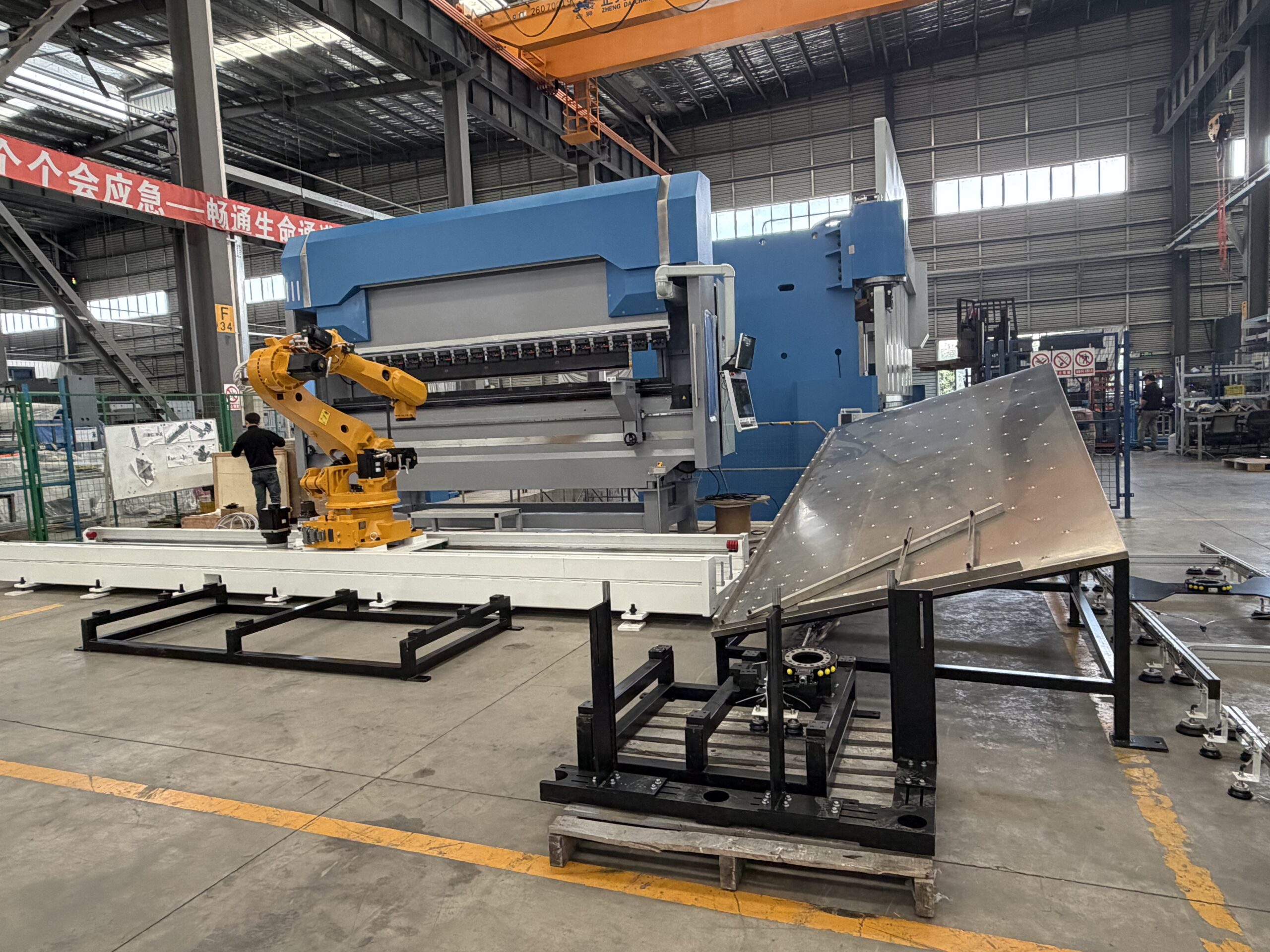
Robotic door frame bending offers a practical approach to automating complex sheet metal forming operations. For manufacturers producing door frames with multiple bends and demanding positioning requirements, automation must coordinate bending accuracy, workpiece handling, and finished-part transfer.
This KLD application concerns a Russian door frame manufacturer using a robotic bending solution designed around complex door frame components.
The Manufacturing Challenge
Door frame components can require multiple bending operations and careful positioning between successive forming steps.
Unlike simple straight bends, complex frame geometries introduce additional handling and alignment requirements.
The manufacturing process must address several connected tasks:
- Positioning workpieces for successive bends
- Maintaining the required bending angles
- Transferring components between processing positions
- Handling finished parts
- Monitoring production activity
These requirements make process integration an important consideration when selecting automation equipment.
The Robotic Door Frame Bending Solution
The application combines an automated press brake with two industrial robots performing different functions.
The bending robot handles workpieces during the forming process, while the palletizing robot manages material transfer and finished-part handling.
The equipment arrangement includes:
- CNC press brake
- Robotic bending unit
- Dedicated palletizing robot
- Gravity positioning station
- Workpiece turnover station
- Automatic loading and unloading mechanisms
- Bending angle correction and compensation
- Industrial IoT production monitoring
- Safety guarding
These components form an integrated system rather than a collection of independently operated machines.
Automated Bending and Angle Compensation
Maintaining bending accuracy is particularly important for complex door frame components.
The system incorporates automatic angle correction and compensation to support the required bending process.
This capability allows bending adjustments to be integrated into the automated operating sequence.
The available case documentation does not specify the angle measurement technology or achieved tolerance. Consequently, no numerical precision claim is made.
Automated Material Handling
Material handling is another important part of the solution.
The bending robot coordinates workpiece movement during forming, while the palletizing robot performs its assigned handling operations.
The turnover station provides secondary positioning within the process.
Separating bending and palletizing responsibilities helps organize the production sequence and reduces the need for manual transfer between these operations.
Production Capacity Considerations
The supplied comparison provides an estimated manual production total of 139 parts during an eight-hour working period.
The automated process is modeled at 208 seconds per workpiece, corresponding to approximately 139 parts over eight hours or 417 parts over 24 hours.
These figures represent production planning estimates, not independently verified factory output.
The main capacity opportunity is the ability to extend automated operating hours, subject to equipment availability, material supply, maintenance, and production conditions.
Flexible Automation and Future Expansion
The layout is designed to be compact and flexible.
Another important feature is the possibility of expanding the arrangement with an additional robotic bending unit while retaining one shared palletizing robot.
This provides a potential route for increasing bending capacity without duplicating every material-handling component.
Any future expansion requires verification of robot utilization, cycle-time coordination, safety arrangements, and available floor space.
The KLD Approach
KLD Machinery develops sheet metal automation solutions around actual production requirements.
This Russian door frame application illustrates the integration of robotic bending, angle compensation, material handling, and production monitoring into one coordinated manufacturing process.
For manufacturers evaluating similar projects, the starting point should be the actual workpiece geometry, bending sequence, required output, and future expansion requirements.
Frequently Asked Questions
Can robotic bending handle complex door frame components?
Yes. This application demonstrates a robotic bending configuration designed for complex door frame workpieces.
Why are two robots used?
One robot performs bending-related handling while the other supports palletizing and material transfer.
Does the system support automatic angle correction?
Yes. Automatic bending angle correction and compensation are included in the described configuration.
Can the production line be expanded?
The system design allows for a future additional robotic bending unit sharing the palletizing robot, subject to engineering validation.
For More Details, Consult Your KLD Sheet Metal Solution Experts
We help you deliver the quality and value required for sheet metal processing equipment.
Consult Our Experts →