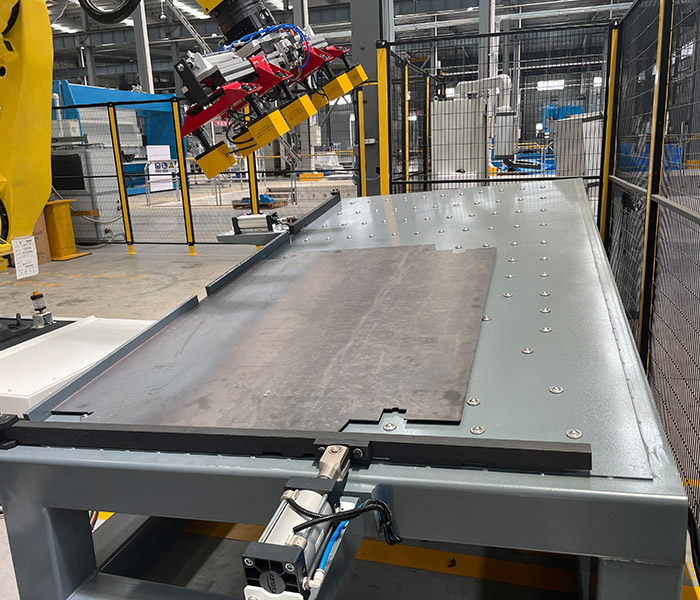
Using Vision Technology to Handle More Variable Production
Traditional robotic automation works best when parts arrive in a predictable position.
However, sheet metal production is not always that simple.
Workpieces can vary in size, orientation, thickness, and product type. For manufacturers producing multiple types of large sheet metal components, fixed-position automation can become restrictive.
This KLD case demonstrates how 3D vision can be integrated into a robotic bending cell to support more flexible production.
The Challenge
The customer was producing large and thick sheet metal components with different dimensions and product types.
A fully fixed automation system would require highly consistent workpiece positioning.
However, when product dimensions vary, the automation system needs additional information to determine where and how the workpiece is positioned.
This is where vision technology becomes valuable.
3D Vision in the Bending Cell
The KLD solution integrates a 3D vision system with a robotic bending cell.
The cell combines:
- CNC press brake
- 6-axis industrial robot
- Robot 7th axis
- 3D vision
- Customized gripper
- Automatic positioning system
- Automatic thickness detection
- Safety guarding
The vision system provides additional information about the workpiece before or during the automated process.
This allows the automation system to work with greater flexibility than a purely fixed-position setup.
Why Vision Matters
In a traditional manual process, the operator can immediately see the workpiece and make positioning adjustments.
A robot does not have the same visual judgment unless sensors or vision systems provide the required information.
A 3D vision system can therefore act as an additional sensing layer.
It can help the system determine relevant information about the workpiece and support automated positioning and handling.
This is particularly useful when the production environment contains different workpiece sizes or configurations.
Supporting Flexible Production
The goal of vision integration is not simply to make the robot “see.”
The larger objective is to reduce the dependence on perfectly standardized positioning.
For manufacturers producing different sheet metal components, this can be an important step toward flexible automation.
Combined with adjustable positioning equipment and a customized gripping system, 3D vision helps create a production cell capable of dealing with greater variation.
Beyond One Product
A major consideration when investing in automation is future production.
A system designed around only one fixed workpiece may have limited value if the manufacturer’s product portfolio changes.
A more flexible architecture can potentially support a wider range of parts.
This is particularly relevant for manufacturers producing:
- Large sheet metal structures
- Heavy panels
- Multiple product sizes
- Different component geometries
- Customized industrial products
The Key Takeaway
3D vision should not be viewed as an isolated technology.
Its value comes from how it works together with:
Robot + Gripper + Positioning + Press Brake + Control System
When these technologies are integrated properly, manufacturers can build bending cells that are more adaptable to real-world production conditions.
KLD Machinery integrates 3D vision, robotic handling, automatic positioning, and CNC bending into customized automation solutions for manufacturers with complex or variable sheet metal production requirements.