Introduction
Buying a press brake is a significant investment.
For many sheet metal manufacturers, the machine will remain in production for years, so choosing the right configuration is much more important than simply selecting the machine with the highest tonnage or the longest bending length.
The right press brake should match your materials, products, production volume, workforce, quality requirements, and future growth.
This guide explains the key factors professional buyers should consider before purchasing a CNC press brake.
1. Start With Your Products
The first mistake many buyers make is starting with machine specifications.
Instead, start with your products.
Make a list of the main components you currently manufacture or expect to manufacture.
For each part, identify:
- Material
- Thickness
- Length
- Width
- Number of bends
- Bend angles
- Required accuracy
- Production quantity
- Batch size
This information provides the foundation for machine selection.
2. Determine the Material Range
Different materials behave differently during bending.
Common sheet metal materials include:
- Mild steel
- Stainless steel
- Aluminum
- Galvanized steel
- High-strength steels
Do not select a machine based only on the material you process most frequently.
Consider the complete range.
If your current production uses mild steel but you expect to expand into higher-strength materials, the machine should have sufficient capacity for that future workload.
3. Determine Material Thickness
Thickness is one of the most important variables.
A machine designed primarily for thin sheet metal does not necessarily need the same capacity as one processing thick structural components.
Consider:
- Minimum thickness
- Typical thickness
- Maximum thickness
- Maximum bending length
The machine should be selected around your real production range rather than the theoretical maximum you might process once every few years.
4. Calculate the Required Tonnage
Press brake tonnage refers to the force the machine can generate.
Required force depends on several variables, including:
- Material type
- Material thickness
- Bending length
- Die opening
- Bending method
- Material strength
This is why there is no single tonnage number that is correct for every application.
A professional machine supplier should be able to help calculate the required force based on your actual parts.
As a buyer, you should also understand the relationship between machine tonnage and tooling capacity.
The machine and tooling must both be suitable for the intended bending operation.
5. Choose the Right Bending Length
Bending length is another fundamental specification.
If the longest sheet you regularly process is 3,000 mm, a 3,000 mm machine may be appropriate for some applications.
But consider your future requirements as well.
A machine that is too short can create production limitations, while an unnecessarily long machine may increase investment cost without providing meaningful benefits.
The ideal choice balances current requirements with realistic future demand.
6. Think About Production Volume
Production volume should strongly influence machine selection.
A job shop producing many different parts in small batches may prioritize flexibility.
An OEM producing large quantities of the same components may prioritize:
- Cycle time
- Automation
- Tool changing
- Repeatability
- Material handling
- Production integration
The same press brake configuration is unlikely to be ideal for both environments.
7. Evaluate the CNC Control
The CNC system is one of the most visible parts of the machine because it directly affects programming and operation.
Important considerations include:
- Ease of programming
- Graphical interface
- Part simulation
- Automatic sequence calculation
- Tool library
- Program storage
- Multi-axis control
- Network connectivity
A powerful control system is valuable only if it helps your production team work more efficiently.
Ease of use is particularly important when skilled operators are difficult to recruit.
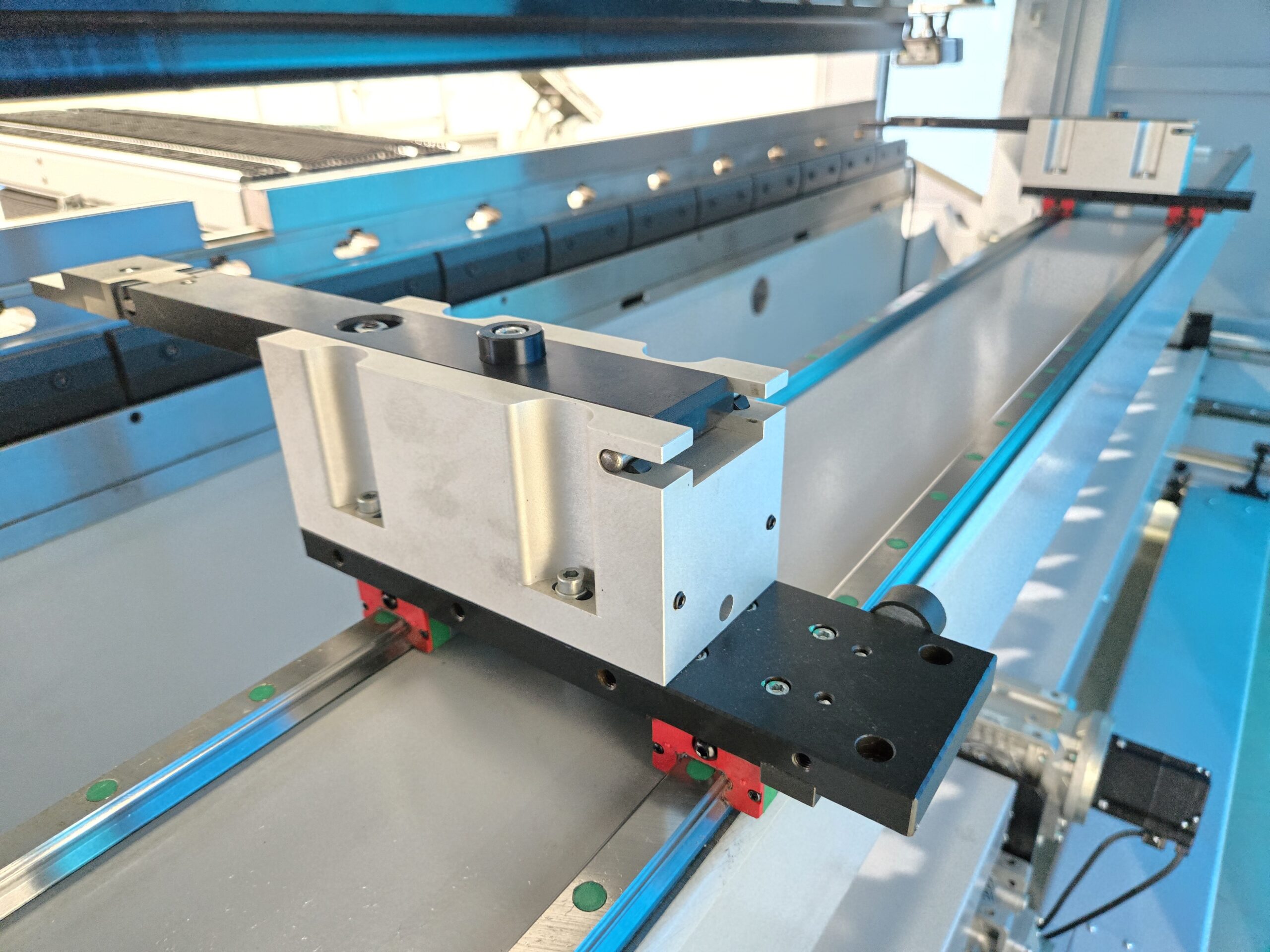
8. Consider the Backgauge
The backgauge determines how the sheet is positioned before bending.
For simple parts, a basic configuration may be sufficient.
For complex components, additional controlled axes can provide greater positioning flexibility.
However, more axes also mean greater investment.
The correct question is not:
“How many axes can I get?”
It is:
“How many axes does my production actually need?”
9. Don’t Ignore Tooling
Tooling is often underestimated during machine purchasing.
The punch and die directly influence:
- Bend angle
- Bend radius
- Surface quality
- Setup time
- Production flexibility
- Part quality
If your factory produces many different components, flexible tooling can provide significant advantages.
Quick-change tooling can also reduce setup time and improve machine utilization.
Quality tooling matters because even an accurate machine can produce inconsistent parts if the tooling is unsuitable or worn.
10. Consider Crowning and Compensation
Long bending machines can experience structural deflection under load.
Without compensation, this can result in angle variation across the bending length.
Crowning systems are designed to compensate for this effect.
For manufacturers producing long components or requiring high dimensional consistency, compensation technology can be an important consideration.
The required system should be evaluated according to bending length, material range, tolerance requirements, and production volume.
11. Look at Energy Consumption
Energy efficiency is increasingly relevant for European manufacturers.
The energy consumption of a press brake depends on its drive technology, operating pattern, machine configuration, and production cycle.
Servo-electric systems can provide advantages in applications where high efficiency and rapid response are important.
Hydraulic systems remain highly capable and versatile for many industrial applications.
The right decision should be based on the complete operating profile rather than simply comparing the rated motor power.
12. Evaluate Automation Potential
Automation should be considered before the machine is purchased, even if you do not plan to automate immediately.
Ask whether the machine can later integrate with:
- Robotic bending
- Automatic loading and unloading
- Tool changing
- Sheet storage
- Material handling
- Production management software
- Laser cutting systems
This creates room for future development.
A machine that works well as a standalone system today but cannot integrate into your future production strategy may become a limitation later.
13. Think About Service and Spare Parts
Price is only one part of the purchasing decision.
A machine that costs less but experiences long downtime can become more expensive over its lifetime.
Before buying, ask about:
- Local technical support
- Spare parts availability
- Remote support
- Installation
- Operator training
- Warranty
- Maintenance requirements
- Response time
For professional manufacturers, after-sales support should be evaluated as part of the machine investment.
14. Calculate Total Cost of Ownership
The purchase price is only the beginning.
Total cost of ownership can include:
- Machine purchase
- Tooling
- Installation
- Training
- Electricity
- Maintenance
- Spare parts
- Labor
- Downtime
- Software
- Automation
- Financing
A machine with a higher initial price may offer better long-term value if it reduces labor, improves productivity, or lowers operating costs.
This is particularly important when comparing machines from different manufacturers.
15. Plan for Future Production
A good press brake should solve today’s problems without creating tomorrow’s limitations.
Consider where your business is going.
Will you:
- Process more parts?
- Add new materials?
- Enter automotive or appliance markets?
- Produce larger components?
- Introduce robotic bending?
- Connect laser cutting and bending?
- Reduce dependence on manual labor?
The machine should fit your expected production strategy.
A Practical Buying Checklist
Before requesting quotations, prepare the following information:
Material: What materials do you process?
Thickness: What are the minimum, typical, and maximum thicknesses?
Bending length: What is the longest component?
Tonnage: What force is required?
Production volume: How many parts do you produce?
Part complexity: How many bends and different geometries are involved?
Accuracy: What tolerances are required?
Tooling: What tooling system do you need?
Automation: Do you plan to automate now or later?
Service: What technical support is available?
This information will allow suppliers to propose a machine based on your actual production rather than simply sending a standard quotation.
Final Thoughts
Choosing a press brake is a production decision, not simply a machine purchase.
The most expensive machine is not necessarily the best machine, and the cheapest machine is rarely the best long-term investment.
The right solution balances:
Capacity + Accuracy + Flexibility + Productivity + Automation + Service + Total Cost of Ownership
For KLD Machinery, this is the foundation of our approach to sheet metal equipment. We believe machine selection should begin with the customer’s production goals and work backward toward the appropriate technology and configuration.
Whether the requirement is a CNC press brake, panel bender, fiber laser cutting machine, or a complete automated production line, the equipment should be engineered around the actual production process.
Frequently Asked Questions
How do I know what size press brake I need?
Start with your material range, thickness, bending length, part geometry, and required tonnage. These factors determine the appropriate machine capacity.
Is a more powerful press brake always better?
No. Excess capacity can increase investment cost without improving production. The machine should be appropriately sized for the actual workload.
How important is the CNC control?
Very important, especially for complex or high-mix production. A good CNC system can simplify programming, improve repeatability, and reduce setup time.
Should I plan for automation when buying a press brake?
Yes. Even if automation is not an immediate requirement, choosing a machine that can integrate with future robotic or material-handling systems can protect your investment.
Should I focus on machine price when comparing suppliers?
No. Compare total cost of ownership, including machine performance, tooling, energy, maintenance, service, downtime, labor, and future automation potential.